
How to validate AI-generated insights and avoid making decisions based on incomplete information.
AI Series: Part 2 of 3
A closer look at how AI shapes business decisions and how to validate the insights it provides.
In the first article, we explored the importance of maintaining context and judgment when using AI to understand business challenges. This article focuses on another common risk: assuming AI-generated insights are complete simply because they appear clear and convincing.
AI is becoming a regular part of how organizations analyze information and make decisions. Whether teams are reviewing interview notes, process data, or performance metrics, AI offers a faster way to organize insights and identify patterns.
That speed is valuable. It helps teams move forward more quickly and makes large amounts of information easier to manage.
At the same time, faster output does not always mean complete understanding.
There are times when AI-generated insights look clear, structured, and ready to act on, while important context or nuance may not be fully represented. Recognizing those moments is not about questioning the value of AI. It is about understanding how to use it effectively so decisions reflect what is actually happening in the business.
What Teams Expect AI to Do… and What Actually Happens
A team has spent weeks gathering information.
They have interviewed employees across departments, reviewed documentation, collected process data, and captured notes from multiple conversations. The goal is clear. They want to understand why results are inconsistent and what is getting in the way of better performance.
In the past, this would have meant days spent organizing notes, identifying themes, and building a clear picture of what is really happening.
Now, they take a different approach.
They upload everything into AI.
The expectation is straightforward. The tool will:
- sort through the data quickly
- identify patterns
- highlight areas that need attention
- and help the team move forward sooner
In minutes, they receive a clean, structured summary. It outlines themes, groups related ideas, and suggests areas to focus.
It looks like progress.
And in many ways, it is.
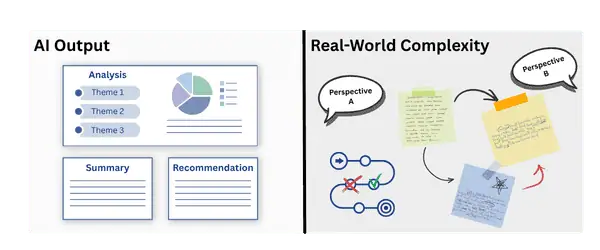
But what often goes unnoticed is how much the end-product depends on how the information was gathered, framed, and interpreted along the way. Details that felt important during conversations may not carry the same weight in a summary. Context that shaped what people shared may not be fully visible in the results.
This is not a failure of the tool or the team. It is simply the nature of how AI works with the information it is given.
AI Output Can Be Clear Without Being Complete
One of the strengths of AI is how clearly it presents information. It turns large amounts of input into organized, readable summaries that are easy to act on.
That clarity is helpful, but it can also create a subtle shift in how the results are interpreted.
When the end-product is well structured and easy to follow, it can feel like the work of understanding is already complete. The themes make sense. The recommendations feel logical. The path forward appears straightforward.
In reality, what feels like an end-product is only the starting point.
AI is organizing information based on patterns. It does not know the full business context, the constraints teams are working within, or the nuance behind each conversation.
That does not make the AI output wrong. It simply means it still needs interpretation.
Where AI Data Analysis Can Become Misaligned
In most cases, the challenges do not come from obvious mistakes. They come from small, reasonable gaps that build over time.
Incomplete Input
Not every perspective is captured. Some roles may be underrepresented. Certain experiences may not come through as strongly in the available data.
Inconsistent or Unclear Input
Transcripts may not fully capture tone or intent. Notes may reflect different interpretations. Data across systems may not align perfectly.
Framing the Problem Too Early
Sometimes the initial question shapes the outcome more than expected. If the team begins with a focus on training, the AI will often organize around that idea, even if other factors are equally important.
This is where the idea of “garbage in, garbage amplified” becomes useful, not as a warning, but as a reminder. AI does not just pass along what it receives. It organizes it and makes it more visible.
When Patterns Look More Certain Than They Are
AI is very effective at identifying patterns across large sets of information.
The challenge is that it cannot always distinguish between what is most important and what is most frequent.
If multiple inputs point toward a similar issue, such as employees struggling in a specific area, the AI may highlight that as a central theme. It will group related comments and present a clear narrative.
That narrative can be helpful.
At the same time, it may not fully reflect why those patterns are showing up. What looks like a skill gap could be influenced by process design, unclear expectations, or competing priorities.
The AI is not misleading by intent. It is simply working within the boundaries of what it was given.
Why Reviewing What AI Produces Matters More Than Ever
One of the biggest changes AI introduces is not what gets done, but where effort is spent.
Before using AI, teams typically invested time in:
- organizing information
- writing summaries
- building the analysis step by step
With AI, that initial work happens quickly.
The time savings are real, but they do not remove the need for thoughtful review. They shift it.
Now, the effort moves into:
- reviewing the AI draft more carefully
- checking whether it reflects what was observed firsthand
- identifying where additional context may be needed
In other words, the time that would have gone into creating the analysis now goes into validating it.
This is an important shift. It keeps the responsibility for understanding with the team, even as the tool accelerates part of the process. Reviewing AI insights accuracy ensures that what gets acted on truly reflects the full picture, not just what was easiest to surface.
What Thoughtful Teams Do Differently
Teams that use AI effectively tend to approach it as part of a broader process.
They do not treat the draft as a final answer. They treat it as a starting point.
They take time to ask:
- What might not be fully represented here?
- Does this reflect what we heard directly from people?
- Where do we need to look more closely?
They stay connected to the work.
They revisit conversations, engage with stakeholders, and compare the AI draft to what they know about how things actually operate.
This does not slow them down. It helps ensure they are moving in the right direction.
Connecting People, Data, and AI
AI is most valuable when it supports, not replaces, the work of understanding.
Data provides visibility into what has been captured. AI helps organize and surface patterns. People bring the context needed to interpret what those patterns mean.
Each of these plays an important role, but none of them are complete on their own.
Real insight comes from connecting:
- the people doing the work
- the data that reflects it
- and the tools that help make sense of it
At Radcom, we help focus on your people and the tools they use to do their work to ensure you get the results you need. We bring these pieces together so that decisions and solutions reflect what is actually happening, not just what is easiest to summarize.
The goal is not better documents. The goal is better understanding.
Using AI Without Losing Direction
AI can help teams move faster and manage complexity more effectively.
The key is staying grounded in what the information represents.
That means:
- treating AI drafts as part of the process
- validating what matters before acting
- and keeping the focus on understanding before solutioning
AI supports the work. It does not replace the thinking behind it.
The Responsibility Still Belongs to You
AI can provide direction quickly.
But it cannot take responsibility for whether that direction aligns with reality.
Leaders still own that responsibility.
When decisions affect people, processes, and outcomes, taking the time to confirm what is really happening is still essential.
AI can accelerate progress.
Making sure that progress is meaningful is still up to you.
Would you like a tool to help you ask the right questions about any AI analysis?
Want to Pressure-Test What You’re Seeing?
If AI is helping your team move faster, but you are not completely confident that the results reflect what is really happening, it may be worth taking a closer look before moving forward.
At Radcom, we help organizations connect people, data, and AI-supported insights so decisions reflect what is actually happening.
If you would like to talk through a challenge you are working through, we are always open to a conversation.
Coming Next in the Series
Once organizations understand how to preserve context and validate AI-generated insights, the next step is learning how to apply AI in ways that support meaningful business outcomes.
Read next: Turning AI Potential into Business Results
Explore the Full AI Series
Part 1: Using AI Without Losing What Matters
A practical look at using AI to understand problems before trying to fix them
Part 2: When AI Gives You the Wrong Answer (and You Don’t Realize It)
A closer look at how AI shapes business decisions and how to validate the insights it provides
Part 3: Turning AI Potential into Business Results
How to focus AI initiatives on the outcomes that matter most to your business.